Amalia
Amalia, the youngest of the three Barnabas siblings, is the quiet, grave, and strikingly self-possessed figure whose single act of defiance—tearing up an obscene summons from the castle official Sortini—dooms her entire family to social ostracism and poverty. She is introduced in the novel's second chapter when K. is led by her brother Barnabas to the family home, where she stands out among the two old parents and her sister Olga for her harsh, direct gaze and her refusal to engage with the stranger. Her story, revealed gradually through her sister Olga's long confession, transforms her from a peripheral figure into the moral and emotional center of the novel's critique of the castle's power, as her refusal to obey an official's degrading command becomes the family's unforgivable crime.
Identity and Introduction
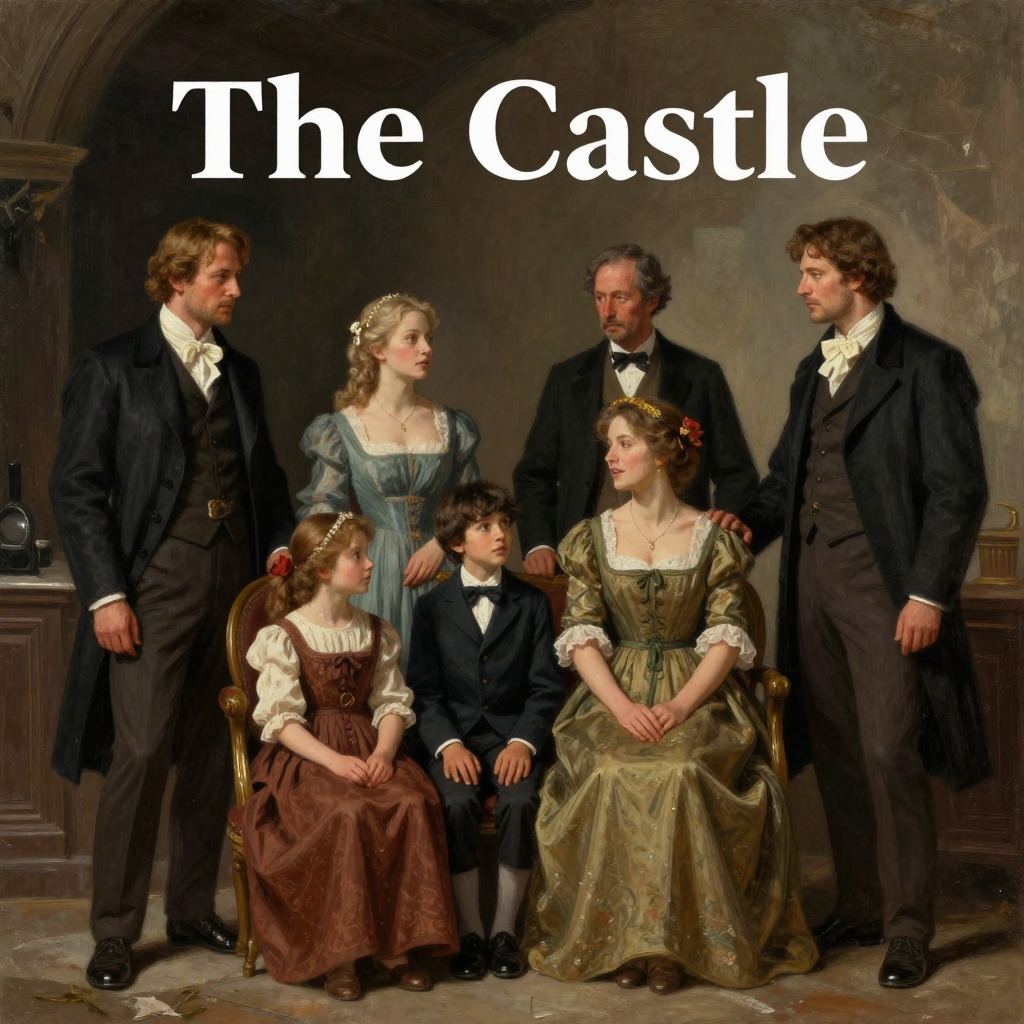
Amalia first appears in the dim, crowded living room of the Barnabas family home, where K. has been brought by her brother, the castle messenger Barnabas. She is described as one of two tall, strong blonde sisters, resembling Barnabas but with harsher features. Unlike her gentler sister Olga, Amalia is marked by a grave, direct gaze that K. finds unsettling; her expression is "unimpressed, but perhaps a little stupid too." She is the youngest of the family, yet she is the one who makes decisions for good and for bad, as Olga later explains. Her physical presence is characterized by a cold, clear, fixed look that seems to pass by what it observes rather than engage with it, a quality K. finds disturbing and attributes to a constant desire for privacy. This initial impression of aloofness and self-containment is the first hint of the extraordinary inner strength that defines her character.
The Fire-Brigade Festival and Sortini's Summons
Three years before K.'s arrival, at a fire-brigade festival held on a meadow outside the village, Amalia's fate was sealed. The castle had donated a new fire engine, and the official Sortini, a small, puny, thoughtful gentleman with a remarkable frown, was present. While the family admired the engine, Sortini noticed Amalia, who stood out in her fine dress with a white blouse ruffled with row upon row of lace, and a Bohemian garnet necklace lent by the landlady of the Bridge Inn. Sortini, who had been leaning against the engine's lever, climbed over the shafts to get closer to her, a gesture the family misunderstood as interest. The next morning, a messenger delivered a letter from Sortini addressed to "the girl with the garnet necklace," commanding her to come to him at the Castle Inn at once, written in the most vulgar language, with harsh threats. Amalia tore the letter up and threw the pieces into the face of the waiting messenger, then closed the window. This act of refusal, which Olga insists was heroic, was the turning point that doomed the family.
The Family's Ruin and Amalia's Silence
Amalia's refusal to obey Sortini's summons, and her insult to his messenger, brought about the family's complete social and economic ruin. Friends and enemies alike abandoned them; customers took back their boots from the father's shoemaking workshop, the fire brigade dismissed him and demanded his diploma, and the family was forced to move to a hovel, ostracized by the entire village. Throughout this devastation, Amalia remained silent and unmoved, taking on the role of head of the family through her silence alone. She cared for her parents, who were broken by the disaster, tending them day and night, while her father and sister futilely petitioned the castle for forgiveness. Olga explains that Amalia bore the affliction with lucidity, seeing the reason where the others saw only consequences, and that she faced the truth and lived, while the rest of the family whispered and hoped in vain. Her silence was not weakness but a form of strength, a refusal to participate in the family's self-abasing attempts to win back favor.
Relationships and the Burden of Leadership
Amalia's relationships are defined by her role as the family's silent leader and her absolute rejection of the castle's authority. She cares for no one but her parents, tending them with superhuman efforts, while remaining distant from her siblings. Olga notes that Amalia cares neither for Barnabas nor for herself, and that the family is dependent on her as if she were the eldest, even though she gives no advice and keeps her own counsel. Her contempt for Barnabas's work as a messenger is evident; she despises it, and her disapproval deepens as his service to the castle seems to bring a glimmer of hope. When K. visits the family, Amalia's interactions are marked by a strange, probing intimacy; she tells him that Olga is in love with him, and she scrutinizes him with her cold, clear gaze. Yet she also reveals a capacity for irony, telling a story of a young man obsessed with the castle who was really thinking of a dish-washer's daughter, a tale that seems to mock K.'s own preoccupations.
Change and the Meaning of Her Defiance
Amalia's character does not change over the course of the novel; she remains the same grave, silent, and unyielding figure, even as her family is destroyed around her. Her defiance of Sortini is presented not as a single act but as a permanent state of being, a refusal that defines her and her family's fate. Olga's comparison of Amalia's case with Frieda's relationship with Klamm highlights the difference: Frieda, who loved Klamm and obeyed him, is accepted, while Amalia, who rejected Sortini, is despised. Amalia's story reveals the brutal logic of the castle's power, where even a victim of an official's abuse is punished for not submitting. Her silence, her refusal to explain or justify herself, becomes a form of resistance that the castle's authority cannot penetrate, making her the novel's most enigmatic and powerful figure of opposition. K., who initially finds her gaze alarming, comes to see her as a person of remarkable strength, and his final assessment, that she is "particularly unhappy," captures the tragic cost of her defiance.